





React JS with Agentic AI | 1.5 Months
A 1.5-month React course that ends where most React courses stop: hooks, routing, global state and APIs, then fifteen days of agentic AI in JavaScript. You build a three-agent support chatbot with tool calling, RAG and a self-checking evaluator. Five classes a week.
Course Overview
A 1.5-month course, five classes a week, that ends where most React courses stop. The first month is React itself - components and JSX, props and Tailwind, hooks and state, side effects and persistence, routing and global state, and working with APIs. The last fifteen days are agentic AI in JavaScript.
The React month
- Getting Started with Modern React - JavaScript revision, modules and export patterns, Git and GitHub, Vite, JSX and components
- Building User Interfaces - props, functions and expressions, Tailwind CSS
- Hooks and State Management - useState, and forms from state to validation
- Side Effects and Data Persistence - useEffect, useRef, local storage, and the Virtual DOM, Fiber and reconciliation
- Routing and Global State - React Router, the Context API, children in props
- APIs - fetching and handling remote data
The agentic AI fifteen days
There is a real difference between a chatbot that replies to whatever you type and an AI system that can look up real information, decide what to do next on its own, hand work to other agents, and check its own answers before anyone sees them. That second kind is agentic AI, and these fifteen days are built around it. Less slides, more building: you write code most days.
You start from a single API call and finish with a working Product Q&A chatbot made of three agents:
- Router - reads the incoming question and decides whether the AI should answer it or a human should
- Responder - answers from a product and FAQ dataset, calling tools to check things like stock
- Evaluator - reviews the Responder's draft against the retrieved facts, and can send it back or escalate it
Along the way you work with tool calling, embeddings and vector databases, RAG, planning and reasoning, multi-agent handoff, agent evaluation and conversation memory - the core techniques behind most production agentic systems. You finish by wrapping the pipeline in an Express and HTML chat interface and presenting it live on Demo Day.
A limited number of API calls are included in the course fee, so you do not need your own account, card or payment method to get started. Use them wisely while you are learning and testing.
Who it is for
Anyone comfortable with JavaScript who wants to build real React applications and then real agentic AI. The course opens with a JavaScript revision rather than an introduction, and the agentic half assumes async/await, fetch and a working terminal, so some prior JavaScript is required. It is a build course, not a machine-learning theory course, and the final project is deliberately scoped to fit the time: a working system, not a production-ready one.
A 1.5-month React course that ends where most React courses stop: hooks, routing, global state and APIs, then fifteen days of agentic AI in JavaScript. You build a three-agent support chatbot with tool calling, RAG and a self-checking evaluator. Five classes a week.
Your Learning Journey
Our curriculum is researched, developed & updated by understanding the global scope & job demands. Conducted by industry-leading expert instructors, the program offers more than 85% of an in-depth practical approach backed by essential theoretical frameworks.
Key Skills You'll Master
Modern React Tooling
A project set up with Vite, and a Git and GitHub workflow around it.
JSX & Components
Component thinking, JSX, and composing an interface out of parts.
Props & Tailwind CSS
Passing data down, and styling components with Tailwind.
Hooks & State
useState, and forms taken from state management through to validation.
Side Effects & Persistence
useEffect, useRef, and local storage for data without a database.
How React Actually Works
The Virtual DOM, Fiber and reconciliation, rather than just the API.
Routing
React Router DOM from basics through to advanced routing.
Global State
The Context API, and passing children through props.
Working with APIs
Fetching and handling remote data inside a React application.
LLM API & Conversation Memory
Node.js setup, raw Claude API calls, and keeping conversation memory across turns.
Tool Calling
Tool schemas and the detect, run, return loop, so the AI checks real data like stock levels instead of guessing.
Embeddings, Vector Databases & RAG
Searching by meaning with Pinecone, and grounding the AI's answers in your own product data.
Multi-Agent Systems
A router, a responder and an evaluator with different jobs, handing work off to each other - including the escalation path to a human.
Agent Evaluation & Robustness
A second agent that checks the first one's work, retries on failure, and a pipeline hardened against ambiguous input and runaway loops.
Chat UI with Express
Wrapping the whole agent pipeline in an Express server and an HTML frontend.
Prerequisites
Comfortable with JavaScript - the course opens on a revision, not an introduction
Comfortable with async/await and calling APIs with fetch - the agentic half builds on them
A laptop with Node.js installed - the project is set up with Vite, and the agents run on Node
Five classes a week, an hour and a half each: a month of React, then fifteen days of agentic AI
Master Essential Tools & Platforms
Gain hands-on experience with tools widely used in the industry.
React
Vite
Tailwind CSS
React Router
Git & GitHub
Node.js
Express.js
Claude API
Pinecone
Everything You Receive
Live classes
Live classes and streaming
Recorded Videos
Get our streamed video
Certificate
Verified
Internship
Real-world experience
Course Curriculum
- JS Revision for React
- JavaScript Modules: encapsulation and export patterns
- Version Control: Git and GitHub workflow
- Understanding React, and setting up a project with Vite
- JSX and Components
- Working with props
- Working with functions and expressions
- Getting started with Tailwind CSS
- Hooks and useState
- Handling forms in React: from state management to validation
- Using local storage: persisting data without a database
- Understanding the useEffect hook
- Managing mutable values and DOM elements with useRef
- Virtual DOM, Fiber, and reconciliation
- React Router DOM basics
- Advanced routing with React Router
- Global data with the Context API
- Children in props
- APIs in React
AI Day 01 - Foundations of Agentic AI
- Chatbot vs. agent: what actually changes
- Why this project needs RAG, routing and evaluation
AI Day 02 - Talking to the LLM API
- Node.js setup, and your first raw Claude API calls
- Keeping conversation memory in a CLI loop
AI Day 03 - Tool Calling
- Tool schemas
- The detect, run, return loop
- Wiring it to a local product catalog, so the AI checks real data instead of guessing
AI Day 04 - Tool Calling Lab
- Extend the tool set against the product catalog
- What the agent does when a tool fails or a product does not exist
AI Day 05 - Embeddings & Vector Databases
- What semantic search actually does: searching by meaning, not exact keywords
- Setting up Pinecone
- Embedding the FAQ dataset
AI Day 06 - Wiring RAG Into the Agent
- Combining retrieved context with tool results
- Answers that are grounded, not guessed
AI Day 07 - RAG Lab
- Run real questions against the FAQ dataset and inspect what is retrieved
- Find and fix the questions that retrieve the wrong thing
AI Day 08 - The Router Agent
- Building the classifier that decides whether to answer
- Or to hand the question off to a human
AI Day 09 - Router to Responder Handoff
- Wiring the real multi-agent fork
- The escalation path
AI Day 10 - Building the Evaluator
- A second agent that checks the draft response against retrieved facts
AI Day 11 - Evaluation as a Gate
- A failed check triggers a retry
- Or falls back to the human escalation path
AI Day 12 - Full Pipeline Lab
- Run questions through all three agents: answered, escalated and retried
- Trace each one through the router, responder and evaluator
AI Day 13 - Robustness Pass
- Handling ambiguous input
- Capping loop iterations
- Tightening prompts across every role
AI Day 14 - Building the Chat UI
- Wrapping the whole pipeline in a simple Express and HTML frontend
AI Day 15 - Demo Day
- Present your finished system to the class: your dataset, your routing logic, and at least one bug you ran into and fixed
FAQs
Yes, at least the basics. The first module opens with a JavaScript revision for React rather than an introduction to programming, and moves quickly into modules, export patterns and JSX. The agentic half also assumes async/await and calling APIs with fetch, and working in a terminal. If you have never written JavaScript, ask us about the web development course first.
A month of React followed by fifteen days of agentic AI - about 1.5 months. Classes run five days a week, an hour and a half each.
The last fifteen days are dedicated to it. A chatbot replies to whatever you type; an agentic system can look up real information, decide what to do next, hand work to other agents and check its own answers before showing them. You build one, starting from a single API call.
A React application with routed pages, global state through the Context API, forms that validate, and data fetched from an API - and a working Product Q&A chatbot made of three agents (a router, a responder and an evaluator), with tool calling, RAG over a product and FAQ dataset, and a chat interface in the browser.
No. A limited number of API calls are included in the course fee, so you do not need your own account, card or payment method. The allowance is limited, so use it wisely while you are learning and testing.
No. It is a build course. You learn how agentic systems are put together - tools, retrieval, routing, evaluation - rather than the mathematics of training a model. The final project is deliberately scoped to fit the time: a working system, not a production-ready one.
Both. Alongside hooks and routing there is a session on the Virtual DOM, Fiber and reconciliation, so you know why a re-render happens rather than only how to trigger one.
Yes. Online and in-person are priced separately; see the pricing on this page. The projects and the daily work are the same either way.
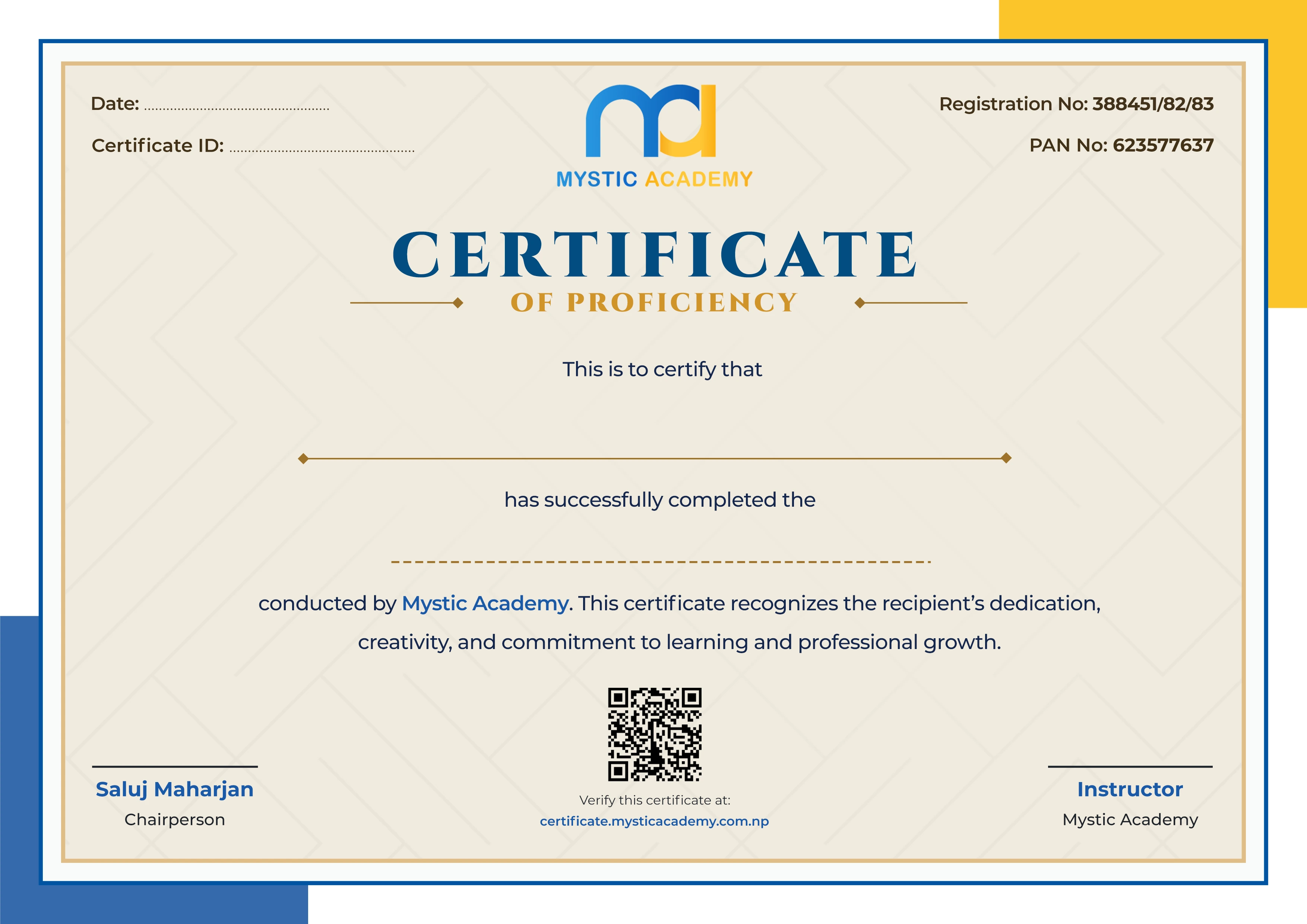
Yes - a Mystic Academy certificate of completion, issued once you have finished the course and cleared your fees.
Available Batches
1 OpenNext Batch
04 Oct 2026
FAQs
Yes, at least the basics. The first module opens with a JavaScript revision for React rather than an introduction to programming, and moves quickly into modules, export patterns and JSX. The agentic half also assumes async/await and calling APIs with fetch, and working in a terminal. If you have never written JavaScript, ask us about the web development course first.
A month of React followed by fifteen days of agentic AI - about 1.5 months. Classes run five days a week, an hour and a half each.
The last fifteen days are dedicated to it. A chatbot replies to whatever you type; an agentic system can look up real information, decide what to do next, hand work to other agents and check its own answers before showing them. You build one, starting from a single API call.
A React application with routed pages, global state through the Context API, forms that validate, and data fetched from an API - and a working Product Q&A chatbot made of three agents (a router, a responder and an evaluator), with tool calling, RAG over a product and FAQ dataset, and a chat interface in the browser.
No. A limited number of API calls are included in the course fee, so you do not need your own account, card or payment method. The allowance is limited, so use it wisely while you are learning and testing.
No. It is a build course. You learn how agentic systems are put together - tools, retrieval, routing, evaluation - rather than the mathematics of training a model. The final project is deliberately scoped to fit the time: a working system, not a production-ready one.
Both. Alongside hooks and routing there is a session on the Virtual DOM, Fiber and reconciliation, so you know why a re-render happens rather than only how to trigger one.
Yes. Online and in-person are priced separately; see the pricing on this page. The projects and the daily work are the same either way.
Yes - a Mystic Academy certificate of completion, issued once you have finished the course and cleared your fees.
Available Batches
1 OpenNext Batch
04 Oct 2026
Locate us
Earn a Certificate on completion
Upgrade your skill and get verified certificates that are recognized by top companies. These certificates help you showcase your expertise and enhance your professional profile.
Already earned a certificate? Verify it here
Similar Courses
Explore other programs that might interest you

Quick Inquiry
Choose Class Schedules :
Notification
Message goes here.